AWS DevOps Agent vs Azure SRE Agent: What Each One Actually Costs to Run, and Why You May End Up With Both
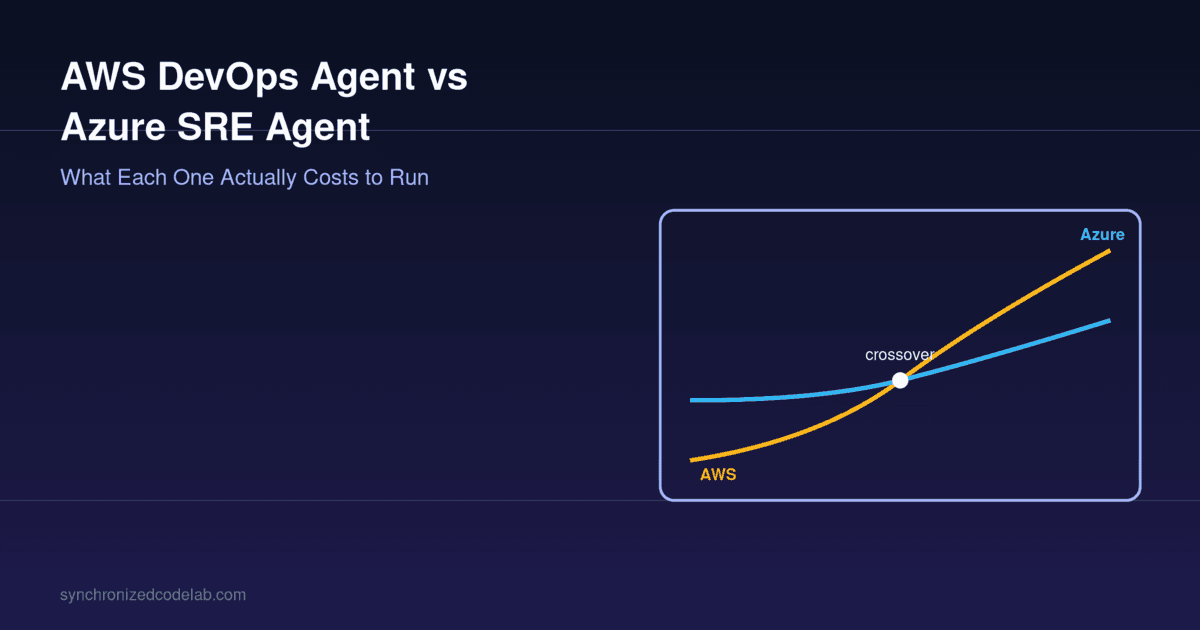
A cost-model comparison of AWS DevOps Agent and Azure SRE Agent at 20, 60, and 150 incidents per month — including the crossover point where each one wins, and the human on-call work neither agent replaces.
If you run production workloads in both AWS and Azure, you are probably not choosing between AWS DevOps Agent and Azure SRE Agent — you will end up running both, because each one is deeply wired into its own cloud's telemetry and IAM, and Microsoft has already shipped cross-cloud interoperability between them over MCP. The structural difference that drives your bill is not the headline rate: Azure charges a fixed always-on floor of 4 Azure Agent Units per agent-hour whether or not anything is happening, while AWS charges roughly $0.0083 per agent-second of active work only and nothing for idle time. That means AWS is cheaper for low incident volumes and Azure gets relatively cheaper as volume climbs — with the crossover landing somewhere between roughly 100 and 210 investigations per month depending on your model choice and AWS Support tier.
What do AWS DevOps Agent and Azure SRE Agent actually do?
Both are autonomous incident-response agents that reached general availability within days of each other in March 2026. Both ingest your monitoring signals, correlate them across services, form a root-cause hypothesis, and either propose or execute a remediation.
The differences worth knowing before you get to cost:
- AWS DevOps Agent (GA March 31, 2026) is built on Amazon Bedrock AgentCore. It bills across three activity categories — investigations, evaluations, and on-demand SRE tasks — and it can reach into Azure and on-prem estates, not just AWS.
- Azure SRE Agent (GA March 2026) is a persistent, provisioned resource: create it, scope it, and it exists — and bills — until deleted. Stopping it does not stop the always-on charge. It supports multiple model providers, and model choice materially changes cost.
If you only run Azure, our Azure SRE Agent pricing guide works through the AAU math in full. This article covers what happens when both are on the same FinOps spreadsheet.
Why is the billing model difference more important than the price difference?
Because one is a subscription and the other is a utility, and that changes which failure mode hurts you.
Azure SRE Agent has a floor. Per Microsoft's pricing and billing documentation, always-on flow bills at 4 AAUs per agent-hour from creation until deletion. At roughly $0.10 per AAU, that's about $0.40/hour, or ~$292 per agent per month before a single incident is investigated. Active work is billed separately on token consumption — Microsoft publishes ~35.3 AAUs for a Claude Opus 4.6 investigation and ~11.7 AAUs on GPT 5.3 Codex. Consequence: the Azure floor multiplies by agent count, not incident count. Three agents is ~$876/month of baseline in a quiet month or a brutal one — consolidating under one broadly-scoped agent is the biggest Azure lever.
AWS DevOps Agent has no floor. At $0.0083 per agent-second there is no idle charge — a quiet month costs close to zero. AWS's own cost forecasting guidance puts a typical 8-minute investigation at about $3.98, and a 15-minute cross-account correlation at about $7.47. Consequence: the AWS bill scales with investigation duration, not agent count. A noisy alert source triggering 40 low-value 12-minute investigations is a real line item — alert filtering and tight runbooks are the AWS lever.
What do AWS DevOps Agent and Azure SRE Agent cost per month at 20, 60, and 150 incidents?
Modeled below at list rates. Assumptions stated explicitly so you can substitute your own: one Azure agent (730 hours/month, $0.10/AAU — verify your region), AWS investigations averaging 8 minutes, incident-investigation workloads only (no full remediations, which cost roughly 2.5x more on both platforms).
| Monthly incidents | AWS DevOps Agent (list) | Azure SRE Agent (Claude Opus 4.6) | Azure SRE Agent (GPT 5.3 Codex) |
|---|---|---|---|
| 20 (low) | $79.60 | $292 base + $70.60 = $362.60 | $292 base + $23.40 = $315.40 |
| 60 (medium) | $238.80 | $292 base + $211.80 = $503.80 | $292 base + $70.20 = $362.20 |
| 150 (high) | $597.00 | $292 base + $529.50 = $821.50 | $292 base + $175.50 = $467.50 |
Where it inverts. Against Azure running the cheaper GPT 5.3 Codex model, AWS's per-second billing stops winning at roughly 104 investigations per month — that is where AWS's $3.98-per-investigation cost has consumed Azure's $292 floor. Against Azure on Claude Opus 4.6, the crossover is far out past 600/month, so Azure's premium model effectively never wins on price alone.
The variable that flips it: AWS Support credits. AWS Business Support+ customers receive monthly DevOps Agent credits worth 30% of the prior month's gross AWS Support spend (Enterprise Support gets 75%; Unified Operations gets 100%). Note the mechanic — it is a percentage of your support bill, not a discount on the agent. A team with a $10K/month AWS spend pays roughly $1,000/month for Business Support, generating a ~$300/month credit. Apply that:
| Monthly incidents | AWS effective (after ~$300 credit) | Azure (GPT 5.3 Codex) |
|---|---|---|
| 20 | $0 | $315.40 |
| 60 | $0 | $362.20 |
| 150 | $297.00 | $467.50 |
The credit pushes the crossover from ~104 investigations/month out to roughly 211/month. On Enterprise Support, it moves further still. If your budget owner is comparing list prices without modeling the credit, the analysis is wrong by a factor of two.
The variable everyone underestimates: investigation duration. If your AWS investigations average 15 minutes rather than 8 — normal for microservice topologies and cross-account traces — the crossover collapses from ~104 to roughly 46 investigations per month. Duration moves the answer more than volume does — measure actual agent-seconds during your trial rather than planning on a vendor's 8-minute example.
Can Azure SRE Agent and AWS DevOps Agent work together across clouds?
Yes — and this is why the either/or framing is already out of date. Microsoft announced that Azure SRE Agent can launch cross-cloud investigations on AWS by delegating to AWS DevOps Agent, with the two interoperating over MCP. AWS DevOps Agent independently spans AWS, Azure, and on-prem.
What that means operationally: an incident that surfaces in Azure Monitor but roots in an AWS-hosted dependency no longer dead-ends at a cloud boundary — Azure SRE Agent holds the thread and hands the AWS-side investigation to the agent with native AWS context and permissions.
What it does not mean: billing does not merge (two meters run — Azure AAUs for the orchestrator plus AWS agent-seconds for the delegated work, so budget for the sum, not the cheaper one); blast radius does not merge (each agent's remediation authority stays bounded by its own cloud's IAM); and neither agent owns the incident (delegation makes the trace continuous, not anyone accountable).
The realistic multi-cloud pattern: run each cloud's native agent in its own estate, pick one as the orchestration entry point so responders have a single front door, and accept two line items.
What do neither agent do that a human still owns?
This is the section missing from every vendor comparison, and it is where the real operational risk lives. Neither agent, in either cloud, handles:
- Severity declaration and escalation judgment. An agent produces a hypothesis. Deciding this is a Sev-1, waking a VP, and pulling in three teams is a judgment call about business impact no agent has context for.
- Customer and stakeholder communication. Status page copy, enterprise-customer notifications, and SLA breach-notice timing are all human, time-critical work.
- Cross-team negotiation. When the fix requires another team to roll back a release they shipped an hour ago, the blocker is organizational, not diagnostic.
- Postmortem and systemic remediation. Agents write excellent incident timelines. They don't run a blameless retro or decide which architectural debt to fund next quarter.
- Alert hygiene. Both agents get more expensive when monitoring is noisy — Azure through tokens, AWS through agent-seconds. Deleting the twelve alerts that fire together every deploy is still a human's job, and it's simultaneously a cost and reliability lever.
- Runbook and knowledge curation. Grounding the agent in skills and documents reduces wasted tokens — curating that context is ongoing human work.
The honest framing: these agents compress mean time to diagnosis. They do not compress mean time to decision, and they do not replace an on-call rotation.
How should you decide which agent runs where, and how should the handoff work?
Start from workload location, not price. Run each cloud's native agent where that cloud's workloads and IAM already live — cross-cloud reach exists, but native context is where diagnostic quality comes from. Then:
- Count agents on Azure, count minutes on AWS. Consolidate Azure scopes to minimize $292 floors; on AWS, filter which alert classes may trigger an investigation at all.
- Model your credit before anything else. On AWS Enterprise Support or Unified Operations, the AWS side may be effectively free at your volume — changing the whole comparison.
- Pick the Azure model per workload, not per org. Cheaper models for high-volume scheduled checks, premium models for complex root-cause work — Microsoft's published AAU rates make this a 3x swing.
- Set hard spending limits in the first 90 days. Azure supports a monthly active-flow AAU cap; watch AWS costs in Cost Explorer with a budget alarm. Both bills scale with incident chaos, exactly when nobody's watching.
- Write the agent-to-human handoff into your on-call policy explicitly. Define which severities the agent may auto-remediate, which need human approval, and the timeout after which an unresolved investigation escalates to a pager regardless of progress.
At Synchronized Codelab, the work clients actually need here is rarely "install the agent" — it's the surrounding engineering: cleaning up alert routing, defining remediation guardrails in IAM, wiring both clouds into one incident front door, and rebuilding the on-call runbook around what the agent now does versus what the responder still must.
FAQ
Is AWS DevOps Agent cheaper than Azure SRE Agent?
At low and medium incident volumes, yes — AWS has no idle charge, while Azure bills roughly $292/month per agent before any work happens. Modeled at 8-minute investigations, AWS stays cheaper until roughly 104 investigations per month against Azure running a cost-efficient model. AWS Support credits push that crossover to around 211/month.
Do I have to choose between AWS DevOps Agent and Azure SRE Agent?
No. Microsoft has announced that Azure SRE Agent can launch cross-cloud investigations on AWS via AWS DevOps Agent, interoperating over MCP, and AWS DevOps Agent spans AWS, Azure, and on-prem. Most genuinely multi-cloud teams run both natively and designate one as the responder's entry point.
Does stopping Azure SRE Agent stop the bill?
No. Stopping the agent halts active-flow (token) charges but the always-on charge of 4 AAUs per agent-hour continues until the agent is deleted. This is the most common source of unexpected Azure SRE Agent spend.
How do AWS Support credits for DevOps Agent actually work?
They are monthly credits calculated as a percentage of your prior month's gross AWS Support spend — 30% for Business Support+, 75% for Enterprise Support, 100% for Unified Operations — and they expire at the end of each month. They are not a discount on the agent's rate, so a large support bill can fully offset moderate agent usage.
What drives AWS DevOps Agent cost more: incident count or investigation length?
Length. At $0.0083 per agent-second, moving from an 8-minute to a 15-minute average investigation nearly doubles per-incident cost and drops the AWS-versus-Azure crossover from roughly 104 to roughly 46 investigations per month. Measure real agent-seconds during your trial rather than trusting example durations.
Can these agents replace an on-call rotation?
No. They compress time to diagnosis, not time to decision. Severity declaration, stakeholder communication, cross-team coordination, postmortems, and alert hygiene remain human-owned regardless of which agent or agents you run.