AWS MCP Server: A Complete Guide for Teams Building AI Agents on AWS
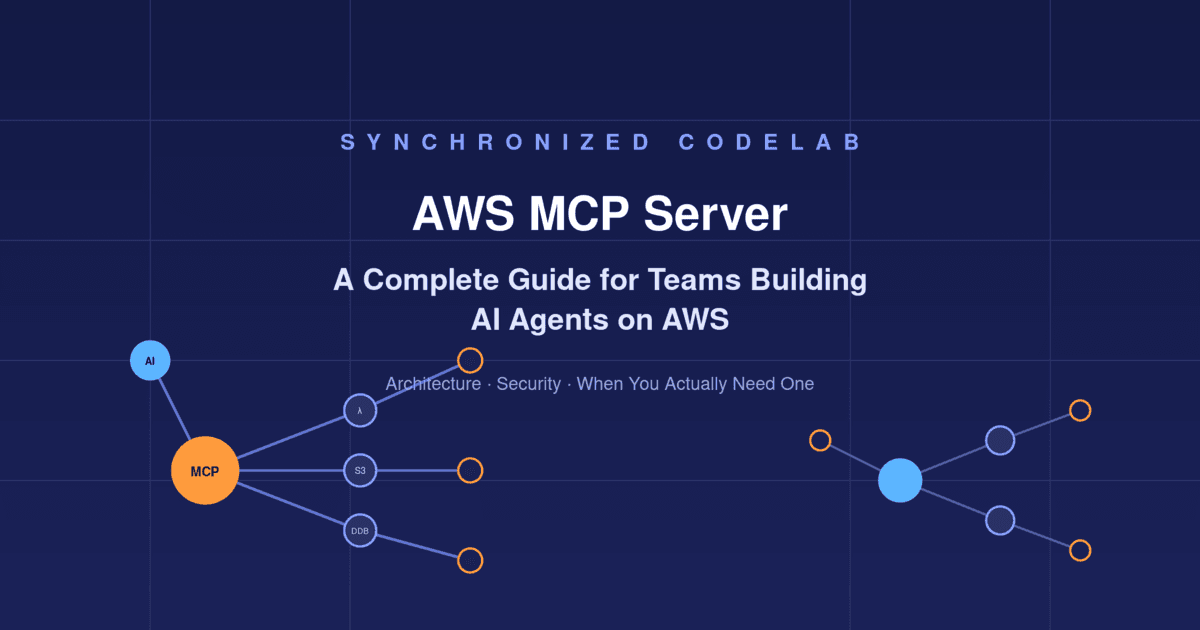
How AWS-hosted Model Context Protocol servers let AI agents call AWS services directly, the architecture patterns that scale, the security risks to close first, and when your team actually needs one.
An AWS MCP server is a Model Context Protocol server, hosted on or built for AWS, that exposes AWS services (Lambda, S3, Bedrock, DynamoDB, CloudWatch, and thousands more APIs) to an AI agent through a standard tool-calling interface. Instead of writing bespoke integration code for every AWS service an agent needs to touch, teams point the agent at one or more MCP servers and let the protocol handle discovery, authentication, and structured responses. For teams building AI agents on AWS in 2026, MCP has become the default way to wire an LLM to real infrastructure rather than a nice-to-have.
What Is the Model Context Protocol, Exactly?
MCP is an open specification, originally released by Anthropic in late 2024, that standardizes how AI applications connect to external tools, data sources, and systems. Before MCP, every agent framework invented its own way to describe tools to a model — different JSON schemas, different auth flows, different error formats. MCP replaces that with one client-server protocol: an MCP client (inside your agent or IDE) talks to an MCP server (which wraps a specific system) over a well-defined transport, and the server advertises "tools," "resources," and "prompts" the model can use.
The protocol has grown fast. Anthropic's ecosystem update in December 2025 reported more than 10,000 active public MCP servers and over 97 million monthly SDK downloads across the Python and TypeScript SDKs combined — evidence this isn't a niche standard but the emerging default for agent-to-system integration.
How Do AWS-Hosted MCP Servers Let Agents Interact With AWS Services?
AWS ships and maintains open-source MCP servers through the awslabs/mcp GitHub repository, covering services like Lambda, ECS, EKS, Amazon Bedrock Knowledge Bases, DynamoDB, CloudWatch, and the AWS Price List API. Each server translates MCP tool calls into authenticated AWS SDK or CLI calls, then returns structured results the model can reason over.
In late 2025, AWS consolidated this further by previewing the AWS MCP Server — a managed, remote MCP server that merges the AWS API MCP server and AWS Knowledge server into a single endpoint. According to AWS's own announcement, it gives agents natural-language access to generate and execute calls against more than 15,000 AWS APIs, plus searchable AWS documentation, without a developer having to hand-code a wrapper per service.
Two integration patterns dominate in practice:
- Local/stdio MCP servers — run as a subprocess next to your agent (common in development, or in a Lambda function using AWS's
run-model-context-protocol-servers-with-aws-lambdaadapter). - Remote/hosted MCP servers — exposed over HTTP with OAuth or IAM-based auth, so multiple agents or teams share one deployment (the direction AWS's managed MCP Server is pushing toward).
What Architecture Patterns Should Teams Building AI Agents on AWS Use?
Three patterns cover most real deployments:
- Bedrock Agents + MCP tool servers. Amazon Bedrock's agent runtime calls out to one or more MCP servers as its action groups, letting you swap or add AWS capabilities (a new Lambda MCP server, a Knowledge Base MCP server) without touching the agent's core prompt or orchestration logic.
- Gateway pattern. A single internal MCP gateway sits in front of several AWS-specific MCP servers (Lambda, ECS, CloudWatch, cost/billing), applying one authentication and logging layer. Agents connect to the gateway, not to each backend server directly — this is the pattern most teams converge on once they have more than two or three MCP servers in production.
- Sidecar-per-agent. Each agent runtime gets its own local MCP server process (via stdio), useful for tightly scoped agents (e.g., a single agent that only needs Lambda deploy tools) where the overhead of a shared gateway isn't justified yet.
Start with the sidecar pattern for a single agent and prototype speed; move to a gateway once you have multiple agents or teams sharing AWS access, since centralizing auth and audit logging there is far cheaper than retrofitting it later.
What Security Considerations Matter Most for AWS MCP Servers?
MCP servers are a new trust boundary, and the failure modes are specific:
- Over-broad IAM roles. An MCP server wrapping the AWS API (like AWS's API MCP server) can, in theory, execute any CLI command the underlying credentials permit. Scope the IAM role or execution policy attached to the MCP server as tightly as the agent's actual job — read-only CloudWatch access for a monitoring agent, not account-admin.
- Prompt injection via tool results. If an MCP server returns content from an untrusted source (a CloudWatch log line, an S3 object, a support ticket body) into the model's context, that content can carry injected instructions. Treat tool outputs as untrusted input and sanitize or constrain what the model can do in response.
- Confused deputy risk on shared/remote servers. A remote MCP server shared across teams needs per-caller authorization, not just a single service credential — otherwise one agent can act with another team's effective permissions. AWS's managed MCP Server model pushes toward IAM-integrated, per-caller auth for exactly this reason.
- No built-in approval gates. MCP doesn't mandate human-in-the-loop confirmation for destructive actions (deleting a stack, terminating an instance). Add your own approval step in the agent orchestration layer for any tool call classified as write/destructive against production AWS resources.
- Unaudited third-party MCP servers. Community MCP servers for AWS-adjacent tools proliferate quickly; only run ones you've reviewed, and prefer AWS's own
awslabs/mcpservers for production paths where possible.
When Does a Team Building AI Agents on AWS Actually Need an MCP Server?
Not every AWS-connected agent needs one. A single agent calling two or three well-known AWS APIs directly through the Bedrock or Lambda SDK is often simpler without adding MCP as a layer. The calculus flips once you hit any of these:
- You're building more than one agent that needs overlapping AWS access — MCP lets you write the AWS integration once and reuse it across agents instead of duplicating SDK glue code.
- You want agents to discover available AWS actions dynamically rather than hard-coding which APIs they can call — useful for general-purpose "cloud ops" or "DevOps copilot" agents.
- You need a consistent audit trail across every AWS action an agent takes, regardless of which model or framework is calling it.
- You're standardizing on Bedrock Agents or an agent framework (LangGraph, CrewAI, custom orchestration) that already speaks MCP, making adoption close to free.
- Your security team requires a single, reviewable integration surface between agents and AWS rather than N bespoke SDK integrations scattered across services.
If none of those apply yet, a direct SDK call is faster to ship. MCP earns its complexity budget once agent count, AWS surface area, or audit requirements grow past what one-off integrations can manage cleanly.
FAQ
Is MCP an AWS-specific technology?
No. MCP is an open, vendor-neutral protocol originally released by Anthropic. AWS has built and open-sourced its own set of MCP servers (in the awslabs/mcp repository) that wrap AWS services, but the protocol itself works with any model or agent framework that implements an MCP client.
Do I need Amazon Bedrock to use AWS MCP servers? No. AWS MCP servers can be called by any MCP-compatible agent, including ones running models outside Bedrock. Bedrock Agents integration is one common pattern, not a requirement.
What's the difference between the AWS API MCP server and the newer AWS MCP Server? The AWS API MCP server (developer preview, mid-2025) let agents generate and run AWS CLI-equivalent calls from natural language. The AWS MCP Server, previewed in late 2025, consolidates that capability with the AWS Knowledge server into one managed, remote endpoint covering documentation search and API execution together.
Can AWS MCP servers run inside AWS Lambda?
Yes. AWS publishes an adapter (run-model-context-protocol-servers-with-aws-lambda) specifically to run existing stdio-based MCP servers inside Lambda functions, which is useful for teams that want serverless, on-demand MCP server instances rather than long-running processes.
How is authentication handled for remote AWS MCP servers? Remote/hosted MCP servers typically use IAM or OAuth-based authentication so that each caller's permissions are scoped individually, rather than every agent sharing one broad service credential — critical for avoiding confused-deputy problems in multi-agent, multi-team deployments.
Is running an MCP server the same as giving an agent unrestricted AWS access? No, and it shouldn't be. An MCP server is just the interface; the actual permission boundary is whatever IAM role or execution policy the server runs under. Scoping that role tightly, adding approval gates for destructive actions, and treating tool outputs as untrusted input are all still the team's responsibility.