Custom Software Development Cost: India vs USA vs Europe TCO
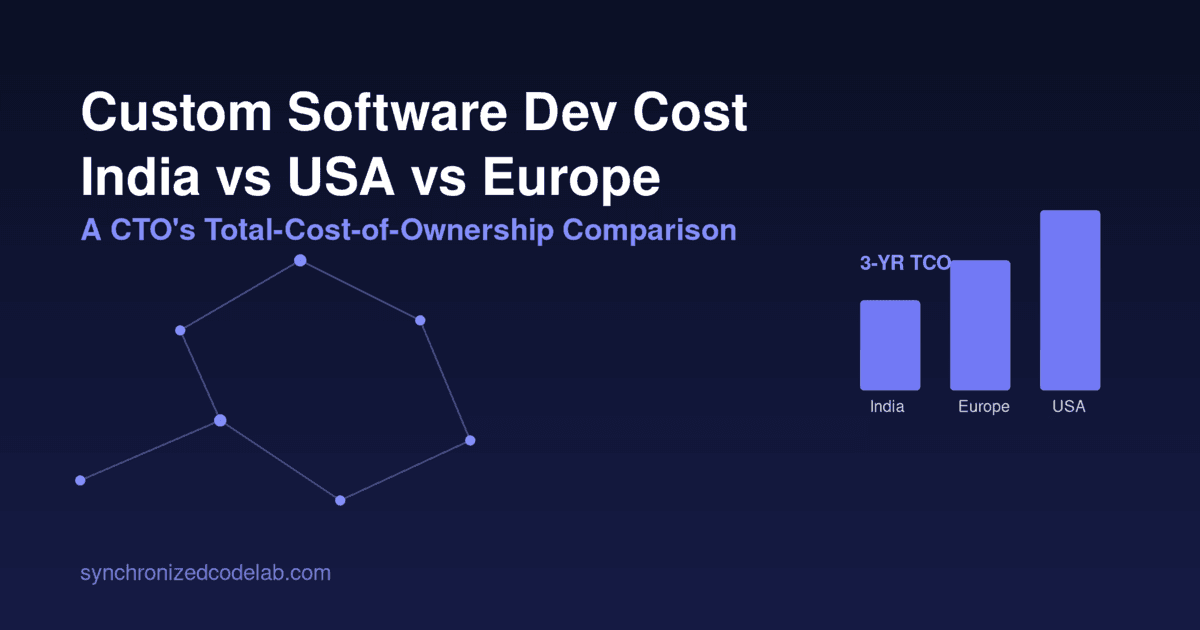
A CTO's total-cost-of-ownership comparison of custom software development in India, the USA, and Europe — beyond hourly rates to management overhead, QA rework, attrition, and maintenance.
Sticker hourly rates say India ($15-$65/hr) is 3-5x cheaper than the USA ($70-$150+/hr) and roughly half the cost of Western Europe. But total cost of ownership (TCO) — which adds management overhead, communication drag, QA rework, attrition-driven ramp-up, and multi-year maintenance — narrows that gap to closer to 2-3x, not 5x. If you're comparing regions on hourly rate alone, you're pricing the wrong variable.
Most vendor comparison pages (and most procurement spreadsheets) stop at the rate card. That's the mistake. A $25/hr offshore team that needs 40% more hours to ship the same feature, plus a $90k/year onshore engineering manager to coordinate it, can cost more per delivered feature than a $65/hr nearshore team that needs almost no oversight. This piece breaks down every cost line CTOs actually pay for, region by region, so you can build your own TCO model instead of trusting a rate table.
How much does custom software development cost in India vs the USA vs Europe?
On raw hourly rate, India runs $15-$65/hr depending on seniority and vendor tier, the USA runs $70-$150+/hr (with California/New York outliers reaching $300/hr), and Western Europe sits in between at roughly $50-$120/hr, while Eastern Europe (Poland, Romania, Ukraine) undercuts Western Europe at $30-$70/hr (Clutch, aggregated via multiple 2026 rate surveys). A mid-size custom software build — say a B2B SaaS MVP requiring 3,000-4,500 engineering hours — typically lands at $60k-$120k built in India, $120k-$180k built in Eastern Europe, $180k-$250k in Western Europe, and $250k-$450k+ in the USA, before any of the hidden costs below are added.
These figures are build cost only. They exclude the coordination, quality, and retention costs that determine what the project actually costs your organization over its useful life — which is where most cost comparisons stop short.
What hidden costs affect total cost of ownership beyond hourly rate?
Five cost categories rarely appear in a vendor's rate card but materially change the real number:
- Management overhead. Offshore engagements with weak vendor process typically require a dedicated onshore technical lead or engineering manager to translate requirements, review architecture decisions, and catch scope drift — often 0.15-0.3 FTE of a senior engineer's time ($20k-$45k/year loaded cost) that a fully co-located Europe or USA team doesn't need.
- Timezone and communication cost. A 9.5-12 hour offset (India-USA) compresses real-time collaboration to a 1-2 hour daily overlap window, which slows decision cycles and increases rework from misunderstood requirements — a cost that shows up as schedule slippage, not a line item.
- QA and rework rates. Vendors billing bottom-of-range hourly rates frequently under-invest in senior QA, pushing defect-fix cycles later into the project where they're 4-5x more expensive to resolve than catching them at code review, per long-standing software engineering economics research (Boehm's cost-of-change curve, still widely cited in current software cost-estimation literature).
- Attrition and ramp-up cost. India's IT industry averages roughly 25% overall attrition, though top offshore engineering firms (EPAM, Cognizant, Globant-tier vendors) run tighter at 11-15% voluntary turnover (NASSCOM 2025 Compensation Benchmarking Survey; public attrition disclosures). Every mid-project developer swap costs 2-6 weeks of ramp-up time that's rarely billed transparently.
- Infrastructure and tooling. CI/CD, staging environments, security scanning, and observability tooling cost roughly the same regardless of region, but are frequently bundled into USA/Europe agency retainers and billed separately (or omitted) by lower-cost offshore vendors — creating an apples-to-oranges quote comparison.
How much does software maintenance cost after launch?
Expect annual maintenance to run 15-25% of your original development cost in the early-to-mid life of the product, rising to 20-40% for legacy or highly regulated systems, according to industry benchmarks tracked by Gartner-derived cost models used across the software cost-estimation industry. On a $150k build, that's $22,500-$37,500 every year just to keep the system running, patched, and compliant — before any new feature work.
This is the number most cost comparisons omit entirely, and it's also where region matters less than vendor quality. A poorly architected $80k India build can cost more to maintain over three years than a well-architected $150k European build, because maintenance cost tracks code quality and technical debt far more than it tracks the original hourly rate.
What is the real multi-year TCO difference between India, USA, and Europe?
Modeling a 3,500-hour SaaS MVP plus three years of maintenance at 20%/year of build cost:
| Region | Build cost | Mgmt overhead (Yr 1) | 3-yr maintenance | 3-yr TCO |
|---|---|---|---|---|
| India (vetted vendor) | $85,000 | $30,000 | $51,000 | ~$166,000 |
| Eastern Europe | $140,000 | $10,000 | $84,000 | ~$234,000 |
| Western Europe | $210,000 | $5,000 | $126,000 | ~$341,000 |
| USA | $320,000 | $0 | $192,000 | ~$512,000 |
The raw build-cost gap between India and the USA is roughly 3.8x. The 3-year TCO gap narrows to roughly 3.1x — still substantial, but the point is that management overhead and communication cost eat into India's advantage, while the USA's near-zero coordination overhead doesn't close nearly enough of the gap to justify the premium for most mid-market projects. Europe (especially Eastern Europe) frequently offers the best overhead-adjusted value: lower coordination cost than India, lower rates than the USA.
Is nearshore or offshore development cheaper on a TCO basis?
Nearshore (Eastern Europe for USA/UK clients, Latin America for USA clients) typically wins on TCO, not sticker rate, because the 2-6 hour timezone overlap eliminates most of the management-overhead and rework costs that erode offshore India's raw rate advantage. Offshore India still wins on TCO when the vendor has senior technical leadership, strong async documentation discipline, and a track record — the coordination tax is a vendor-maturity problem, not a geography problem. The mistake CTOs make is assuming "nearshore" or "offshore" as a category determines TCO; in practice, vendor process maturity explains more cost variance within a region than the average difference between regions.
How should a CTO actually build a cost comparison instead of trusting a rate card?
Build a five-line model for every vendor you're evaluating: (1) quoted hourly rate x estimated hours, (2) your required management overhead in FTE-hours/week x your loaded internal rate, (3) an explicit QA/rework buffer (10-20% of build cost is a defensible starting assumption for vendors without a demonstrated senior QA process), (4) attrition risk — ask for the vendor's actual voluntary turnover rate, not an assurance, (5) a Year 1-3 maintenance estimate at 15-25% of build cost. Score every vendor proposal against all five lines, not just line one. This is the single highest-leverage change a CTO can make to vendor comparison — it's also the exact due-diligence process we run with prospective clients before scoping a build.
FAQ
Is India still cheaper than the USA for custom software development in 2026? Yes, on both raw rate and total cost of ownership — but the gap has narrowed from the popular "5-10x cheaper" claim to roughly 3-3.5x once management overhead, QA, and maintenance are included in the comparison.
What's a realistic hourly rate range for a senior offshore developer in India? Senior India-based developers with production experience typically bill $38-$65/hr through established vendors, well above the $15-$22/hr junior tier often used in marketing rate cards.
Why do two vendors quote wildly different prices for the same project scope? Differences usually come from hour estimation (junior-heavy teams need more hours), what's bundled (QA, infra, PM time), and whether maintenance/support is priced separately — not just the hourly rate itself.
How much should I budget for software maintenance every year? Plan for 15-25% of your original build cost annually in the first few years, rising toward 20-40% for complex, regulated, or legacy-heavy systems.
Does nearshore development eliminate the communication cost problem? Mostly. A 2-6 hour timezone overlap (typical for Eastern Europe-to-USA or Latin America-to-USA pairings) allows near-daily real-time collaboration, which is the single biggest driver of the coordination cost gap versus full offshore.
Should I choose a vendor based on lowest hourly rate? No. Lowest hourly rate correlates poorly with lowest total cost — teams with weak QA or high attrition frequently cost more per delivered, working feature than a moderately priced team with a mature process.