.NET Microservices in 2026: A Guide for CTOs and Engineering Leads
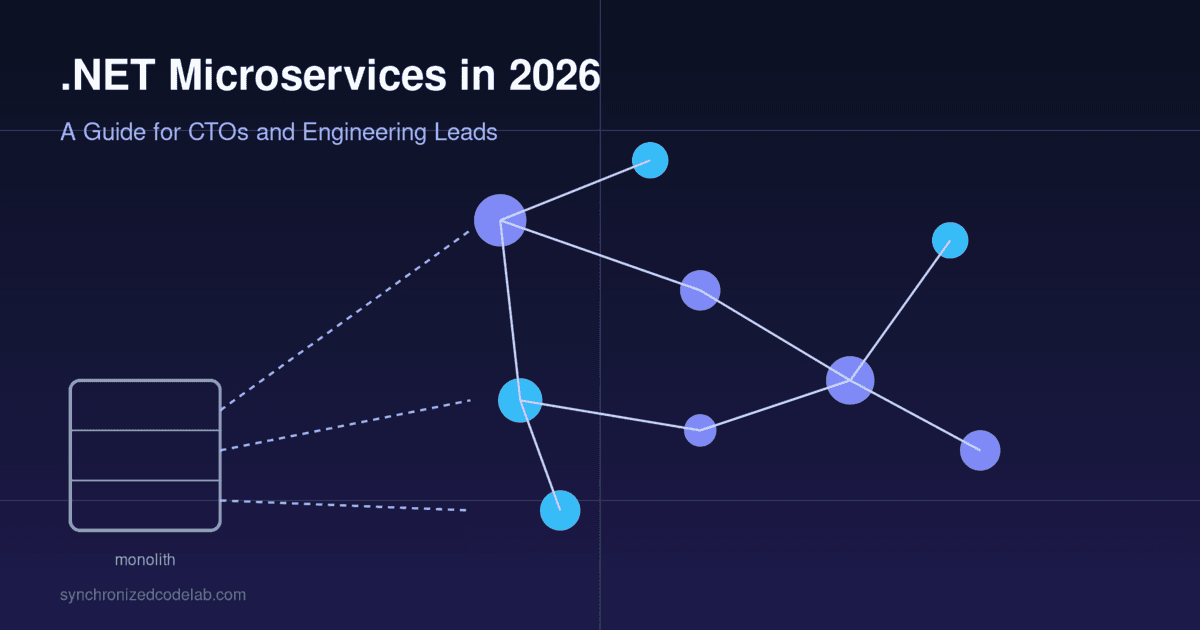
A practical decision framework for when to split a .NET monolith into microservices in 2026 — minimal APIs, gRPC, .NET Aspire, common pitfalls, and how to avoid over-decomposing your architecture.
Splitting a .NET monolith into microservices only pays off when a specific team, deployment, or scaling bottleneck already exists — not because "microservices" is the modern default. In 2026, the practical path for most .NET shops is minimal APIs for lean service boundaries, gRPC for internal service-to-service calls, and .NET Aspire for local orchestration and service discovery, applied selectively rather than as a wholesale rewrite. This guide gives CTOs and engineering leads a concrete decision framework, the .NET-specific patterns that actually work in production, and the pitfalls that turn a microservices migration into a multi-year drag on velocity.
Why are CTOs still debating monolith vs. microservices in 2026?
Because the data doesn't support a clean winner. According to Gartner's Peer Community research, 74% of surveyed organizations are currently using microservices architecture, with another 23% planning to adopt them within six months — adoption is nearly universal on paper. But the CNCF's 2025 Annual Survey found that 42% of organizations that initially adopted microservices have since consolidated some services back into larger deployable units, often as modular monoliths, citing debugging complexity, operational overhead, and network latency as the primary drivers. Both numbers are true at once: microservices remain the right call for some systems and the wrong call for others, and a growing number of teams over-corrected in one direction and are now walking it back. That's the context CTOs are actually operating in — not a settled debate, but an active correction.
When should a .NET team actually split a monolith?
Split when you can point to one of these, backed by evidence, not intuition:
- Independent scaling needs. One module (e.g., an image-processing or reporting pipeline) consumes 10x the CPU/memory of the rest of the app and forces you to over-provision the entire monolith just to keep that one path fast.
- Deployment coupling is blocking releases. Multiple teams queue behind a single deploy pipeline, and a bug in one module blocks releases for unrelated features. If your release cadence is measured in weeks because of merge conflicts and regression risk across unrelated domains, that's a real signal.
- Team topology mismatch. You've grown past roughly 3-4 engineering teams and they're stepping on each other inside the same codebase, with unclear code ownership boundaries.
- Divergent technology or compliance requirements. A subset of functionality needs different scaling, a different data residency boundary, or a different tech stack (e.g., a Python ML service alongside a C# core).
If none of these apply, a modular monolith — internal project boundaries enforced by conventions or a tool like NetArchTest fitness functions, with clean interfaces between modules — gets you most of the maintainability benefit without the operational tax. Don't split for resume-driven architecture or because a conference talk made microservices sound inevitable.
What .NET-specific patterns work for microservices in 2026?
Minimal APIs for service boundaries. ASP.NET Core's minimal API model strips the controller ceremony and gives each service a small, explicit surface — ideal for services that should stay small by design. Pair each service with its own Program.cs, its own dependency graph, and its own deployable unit; resist the urge to share a common "shared kernel" project across service boundaries, since that recreates monolith coupling with extra deployment overhead.
gRPC for internal service-to-service calls. For synchronous internal calls between .NET services, gRPC (via Grpc.AspNetCore) gives you strongly-typed contracts (protobuf), HTTP/2 multiplexing, and materially lower serialization overhead than JSON-over-REST for high-frequency internal traffic. Reserve REST/JSON for public or partner-facing APIs where tooling and broad client compatibility matter more than raw throughput.
.NET Aspire for orchestration and local dev. Aspire's AppHost model lets you define services, their dependencies (Postgres, Redis, message brokers), and their wiring in C# code rather than hand-rolled docker-compose files or Kubernetes manifests for local development. It doesn't replace Kubernetes or your cloud orchestrator in production, but it removes the "works on my machine" tax that historically made local multi-service development painful, and it ships built-in OpenTelemetry wiring for distributed tracing across services from day one.
Async messaging for cross-boundary writes. Use a message broker (Azure Service Bus, RabbitMQ, or Kafka via a .NET client) for anything that isn't a synchronous read — order placed, inventory adjusted, notification triggered. This decouples service availability: if the notification service is down, order placement shouldn't fail.
Contract testing over end-to-end testing. Use Pact.NET or an equivalent contract-testing setup between service boundaries. Full end-to-end test suites across a distributed .NET system become slow and flaky fast; contract tests catch breaking changes at the boundary without needing every service running.
What are the most common pitfalls in .NET microservices migrations?
- Distributed monolith syndrome. Services are deployed independently but still share a database or a tightly coupled release train — you get all the operational complexity of microservices with none of the independence benefits. If two services must deploy together to avoid breaking, they're not actually independent services.
- Chatty synchronous chains. A single user request that fans out into eight synchronous gRPC calls across services means eight points of failure and eight times the latency budget. Cache aggressively, batch calls, or collapse chatty service pairs back into one service.
- No distributed tracing from day one. Without OpenTelemetry (or equivalent) wired in before the first service ships, a production incident that spans three services becomes an unstructured log-grepping exercise. Aspire makes this close to free to set up — use it.
- Underestimating data consistency work. Splitting a service usually means splitting its data. Sagas, outbox patterns, and eventual consistency aren't optional extras — they're the actual engineering cost of the split, and teams that skip this step end up with silent data drift between services.
- Treating the migration as a rewrite instead of a strangler. Big-bang rewrites of a working monolith carry enormous delivery risk. Use the strangler fig pattern: put a routing layer in front of the monolith, peel off one bounded context at a time, and keep the monolith serving everything else until each extracted service is proven in production.
Is .NET Aspire a replacement for Kubernetes?
No. Aspire is a development-time and orchestration-definition tool — it standardizes how you describe services, their dependencies, and their observability wiring in C#, and it's genuinely useful for local development and for generating deployment manifests. But production orchestration, scaling, and failover in most .NET shops still runs on Kubernetes (AKS, EKS, or self-managed) or a PaaS like Azure Container Apps. Treat Aspire as the layer that makes local multi-service .NET development sane, and keep your production orchestrator decision separate.
How do you decide: monolith, modular monolith, or microservices?
Use this order of operations:
- Start with a modular monolith unless you already have concrete evidence (from the list above) that you need service-level independence.
- Identify the one or two bounded contexts causing the most pain — usually the ones with the worst scaling mismatch or the most cross-team deployment friction.
- Extract those specific services first, using the strangler pattern, minimal APIs, and gRPC for internal calls.
- Wire in distributed tracing and contract tests before the second service ships, not after an incident forces the issue.
- Re-evaluate every 6-12 months. Given that 42% of organizations in the CNCF survey are already walking back over-decomposed systems, a periodic health check — are these services still earning their operational cost? — should be a standing agenda item, not a one-time architecture decision.
FAQ
Do I need microservices to use .NET Aspire? No. Aspire works fine for orchestrating a modular monolith alongside its dependencies (database, cache, message broker) during local development — it isn't microservices-specific tooling.
Is gRPC required for .NET microservices? No, but it's the better default for internal, high-frequency service-to-service calls in a homogeneous .NET environment. Use REST/JSON where you need broad client compatibility, such as public APIs or partner integrations.
How many microservices should a mid-size engineering team run? There's no universal number, but a common rule of thumb is one service per team that can independently own, deploy, and be on-call for it. If services outnumber teams by a wide margin, you likely have over-decomposition and rising coordination overhead.
What's the biggest hidden cost of microservices? Data consistency and operational tooling — distributed tracing, contract testing, and saga/outbox patterns for cross-service writes. Teams that budget only for the code split and not for this supporting infrastructure consistently underestimate migration cost and timeline.
Should we migrate our .NET monolith to microservices in 2026? Only if you can point to a specific, evidenced bottleneck (scaling mismatch, deployment coupling, team topology, or compliance divergence). If not, invest in a modular monolith with enforced boundaries — you'll get most of the benefit without the distributed-systems tax.
Can minimal APIs and traditional MVC controllers coexist in the same .NET solution during a migration? Yes. It's common and low-risk to introduce minimal API endpoints for newly extracted services while leaving existing MVC controllers untouched in the monolith until that bounded context is ready to move.