Cross-Platform App Cost in 2026: Flutter vs React Native vs Capacitor (Build + 3-Year Run Cost)
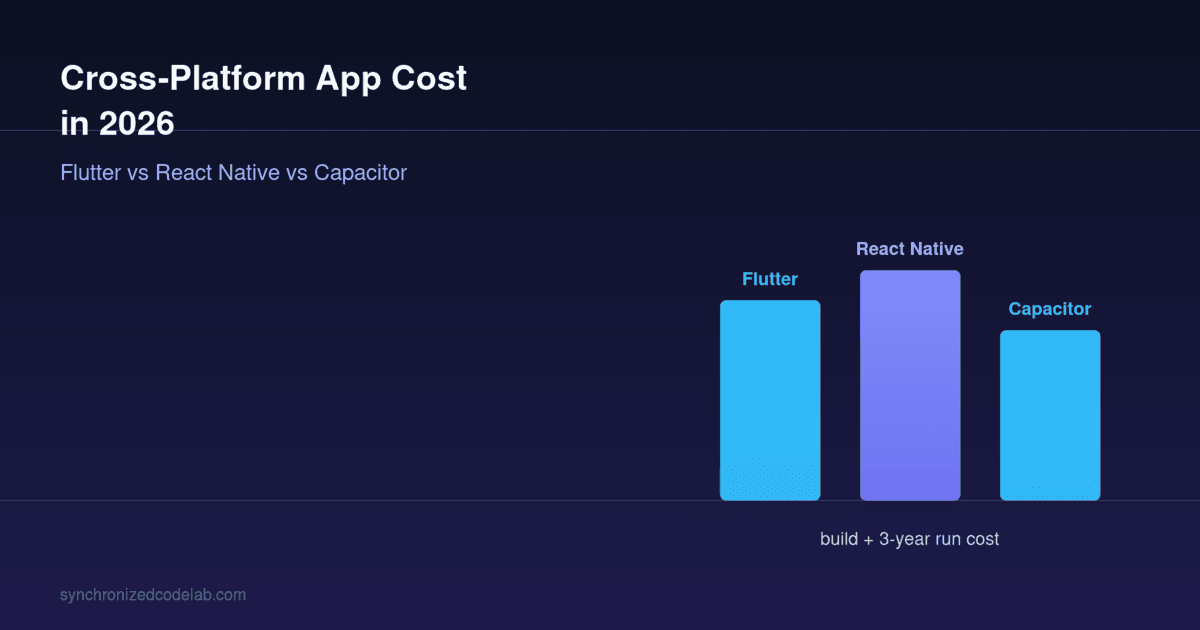
One reference app — five screens, auth, offline sync, push — costed across Flutter, React Native and Capacitor, with build, release ops and three years of maintenance separated. Plus the line item almost no comparison includes: what it costs when the stack does not match the team you already have.
A cross-platform app with five screens, email and social sign-in, offline sync and push notifications costs $110,000–$125,000 to build in 2026 at a blended $65/hour, plus $70,000–$110,000 to run over three years — a three-year total cost of ownership of roughly $185,000–$235,000. Across Flutter, React Native and Capacitor the same spec varies by only 10–15%, about $28,000 over three years. The cost gap between a team using a stack it already knows and the same team learning a new one is $12,000–$30,000 on the first build alone — which makes framework choice the second-biggest cost decision here, not the first.
Rescale every figure below by your own blended rate. Accelerance's 2026 Global Software Development Rates guide, based on a survey of 60 delivery partners, puts senior developer rates at $31–$41/hour in Asia, $60–$75 in Latin America and $64–$76 in Central and Eastern Europe — a 2x spread that dwarfs anything the frameworks do to a budget. Our India vs USA vs Europe TCO comparison covers those regional effects in detail.
This is the cost article. For the go/no-go question, see the native vs cross-platform decision framework; for the engineering-level feature comparison, see Capacitor vs React Native.
How much does it cost to develop a cross-platform app in 2026?
Reference app: five screens, email plus OAuth sign-in, offline-first local store with server sync and conflict handling, push notifications, analytics, iOS and Android, no heavy custom animation. Two mobile engineers with fractional design, QA and delivery management, at a blended $65/hour.
| Line item | Flutter | React Native | Capacitor |
|---|---|---|---|
| Discovery, UX and UI design | $13,000 | $13,000 | $12,000 |
| Client app build | $57,000 | $59,000 | $47,000 |
| Backend, sync API, conflict handling | $22,000 | $22,000 | $22,000 |
| Auth, push, third-party integrations | $9,000 | $8,000 | $9,000 |
| QA and device matrix | $13,000 | $14,000 | $17,000 |
| Store setup, signing, first release | $5,000 | $5,000 | $6,000 |
| Build total | $119,000 | $121,000 | $113,000 |
| Store and release ops (3 years) | $9,000 | $9,000 | $11,000 |
| Maintenance and upgrades (3 years) | $75,000 | $89,000 | $67,000 |
| 3-year TCO | $203,000 | $219,000 | $191,000 |
Read the columns, then read the spread: $28,000 over three years, roughly 13%. Real money — but less than one senior engineer for four months, and less than the cost of putting your team on the wrong stack.
Capacitor is cheapest to build because the UI is web code your team likely already writes, shipped in a native shell; it is the most expensive to QA because you are testing a web runtime across two OS families' WebView versions. React Native's higher maintenance figure is version churn, explained below. Flutter's build cost sits in the middle with the most stable maintenance profile of the three — if you have Dart people.
Why does your existing team change the cost more than the framework does?
Because the first project on an unfamiliar framework runs 20–30% slower, and that penalty applies to roughly two-thirds of the build. On a $120,000 project that is $12,000–$30,000 of pure ramp — more than the entire three-year gap between the three frameworks.
That is not a theoretical number. Google's own Google Pay case study describes retraining about 50 engineers over six months before the Flutter rewrite properly started, eventually scaling to nearly 180 engineers. Retraining was a budgeted project phase. Most mobile estimates leave it out of the spreadsheet entirely.
Put it in as an explicit line item:
| Team you have today | Flutter ramp | React Native ramp | Capacitor ramp |
|---|---|---|---|
| React / TypeScript web team | +$18k–$24k | +$3k–$6k | $0–$3k |
| Angular or Vue web team | +$18k–$24k | +$10k–$14k | +$2k–$5k |
| Native iOS + Android team | +$12k–$18k | +$14k–$20k | +$22k–$30k |
| Existing Flutter / Dart team | $0 | +$16k–$22k | +$14k–$20k |
| No in-house mobile team (agency build) | $0 | $0 | $0 |
Two rows deserve explanation. A native iOS/Android team ramps into Capacitor most expensively, not least — the framework itself is trivial, but the web platform underneath it (bundlers, CSS layout, the DOM event model, npm dependency management) is a discipline they do not have. And if you hire a partner rather than using in-house engineers, ramp is zero — which is exactly why agency quotes across the three frameworks look so similar. The ramp line item has been absorbed by whoever you hired.
Decision rule: if the ramp column differs by more than 10% of build cost, choose the low-ramp framework unless a hard product requirement rules it out.
Is Flutter cheaper than React Native?
Only if you already have Dart engineers. Flutter's efficiency advantage is real and documented — Google Pay reported that shipping a feature to both platforms in Flutter took about 1.2x the effort of building it once, against roughly 2x for two native codebases, and shrank its codebase from 1.7 million lines to 1.1 million. But that gain is measured against native, not against React Native, and only a fluent team collects it.
Each framework's cost curve bends somewhere different:
Capacitor bends on interaction complexity. One 2026 benchmark from Oflight measured cold start at 2.3s for Capacitor, 1.8s for React Native and 1.2s for Flutter on a mid-range Android device — treat that as a single vendor benchmark rather than independent research, though the direction matches what we see shipping. For internal tools, B2B portals, booking flows and content apps, 2.3s is invisible and Capacitor stays cheapest through year three. It becomes expensive at the mid-project moment when the interaction design turns out to need native fidelity: that is a rebuild, not a refactor, and it costs 40–60% of the original build.
React Native bends on version churn. The React Native working group froze the legacy architecture on 2 June 2025, and React Native 0.82 removed the option to disable the New Architecture. Inheriting an older RN codebase makes migration a real line item — budget 3–8 engineer-weeks, driven almost entirely by how many unmaintained third-party native modules you depend on. New 2026 builds skip this one, but the pattern recurs: React Native's dependency surface is wide, and wide surfaces churn.
Flutter bends on talent supply and internal architecture. The framework is stable; the expensive decisions sit inside it, and state management compounds fastest — we compare the options in Bloc vs Riverpod vs Provider.
What does cross-platform app maintenance actually cost over three years?
Budget 20–28% of build cost per year — $22,000–$34,000 annually on a $120,000 app. The largest and least negotiable share is OS-version churn, because both stores set hard deadlines you cannot defer:
- Apple: from 28 April 2026, every app uploaded to App Store Connect must be built with the iOS 26 SDK or later.
- Google Play: from 31 August 2026, new apps and updates must target Android 16 (API level 36); existing apps need API 35 to stay available to new users on newer devices.
Those arrive every year. Capacitor adds a layer of its own: version 8.5, released July 2026, was a breaking minor that adopted UIScene ahead of iOS 27.
The line items most budgets miss:
| Hidden line item | 3-year cost | Why it appears |
|---|---|---|
| Native module escape hatches | $6k–$20k | One requirement — BLE, background location, a payment SDK — with no maintained plugin forces native code plus a bridge, and now you maintain three codebases |
| Plugin and dependency maintenance | $8k–$18k | Community plugins go unmaintained; you fork, patch or replace |
| OS churn and SDK deadlines | $12k–$24k | Two mandatory store deadlines a year, each needing regression testing on both platforms |
| Design/dev handoff drift | $4k–$12k | Web design systems do not survive contact with platform conventions; Capacitor projects pay this most |
| Framework major-version upgrades | $6k–$18k | RN architecture migration, Flutter/Dart major bumps, Capacitor breaking minors |
The native escape-hatch row is the one that quietly wrecks Capacitor and React Native budgets. It is cheap when a maintained plugin exists and expensive when it does not — so audit your hardware and OS-integration requirements against the plugin ecosystem before the estimate, not during sprint four.
What do you actually get for $40k, $110k or $250k?
| ~$40,000 | ~$110,000 | ~$250,000 | |
|---|---|---|---|
| Scope | 4–6 screens, one core flow | 10–18 screens, 2–3 flows | 25+ screens, multi-role |
| Auth | Email + one social provider | SSO, MFA, role permissions | Enterprise SSO, SCIM, audit logs |
| Data | Online-only REST | Offline-first with sync | Offline-first, conflict resolution, background sync |
| Backend | Managed BaaS | Custom API on managed infra | Custom services, CI/CD, IaC, staging |
| Design | Themed component library | Custom UI on a design system | Design system, motion, accessibility audit |
| QA | Manual, 4–6 devices | Automated E2E + device cloud | Full test pyramid, perf budgets, release gates |
| Timeline | 8–12 weeks | 16–24 weeks | 9–14 months |
| Realistic fit | Capacitor or React Native | Any of the three | Flutter or React Native |
At $40,000 the framework is decided by your team, full stop — there is no budget for a learning curve. At $250,000 it is decided by the product: if the interaction model is demanding, Capacitor's curve bends against you, and the Flutter or React Native premium is noise at that scale.
FAQ
How much does it cost to develop a cross-platform app in 2026?
A production app with five to eight screens, authentication, offline sync and push notifications runs $110,000–$125,000 to build at a blended $65/hour, and $185,000–$235,000 over three years including maintenance and release operations. Simple single-flow apps start near $40,000; multi-role enterprise apps reach $250,000 and up. Regional rate differences move these numbers further than framework choice does.
Is Capacitor the cheapest cross-platform framework?
Usually yes, by roughly 5–10% on build and slightly more on three-year maintenance — mainly because you reuse web skills and web code. The saving reverses if your product needs native-grade gestures, animation or fast cold start, where retrofitting native fidelity costs 40–60% of the original build. Capacitor is strongest for internal tools, B2B portals and content-driven apps.
How much does cross-platform app maintenance cost per year?
Plan for 20–28% of the original build cost annually, so $22,000–$34,000 per year on a $120,000 app. Mandatory store SDK deadlines from Apple and Google account for the largest fixed share, followed by dependency and plugin maintenance. Apps with heavy device-hardware integration sit at the top of that band.
Does framework choice or team experience affect app cost more?
Team experience, by a clear margin. The three-year spread between Flutter, React Native and Capacitor on an identical spec is around 13%, while a team's first project on an unfamiliar framework runs 20–30% slower — $12,000–$30,000 on a typical build. Choose the framework your team can be productive in from week one unless a product requirement forbids it.
Is it cheaper to build cross-platform than two native apps?
Yes, in most cases. Google Pay reported that shipping a feature to both platforms in Flutter took about 1.2x the effort of building it once, versus roughly 2x with separate native codebases. The exception is apps whose value is platform-specific — deep OS integrations, AR, high-frame-rate graphics — where the escape-hatch cost erodes the saving.
Getting a number you can defend
The fastest way to a budget you can take to a board is to price your actual feature list against the team you actually have, including the ramp line. That is a two-to-three-hour exercise, not a proposal.
Talk to Synchronized Codelab if you want that estimate built with you — including the version where we tell you your existing web team should just ship Capacitor and keep the difference.