What It Actually Costs to Build and Run a Production AI Agent in 2026
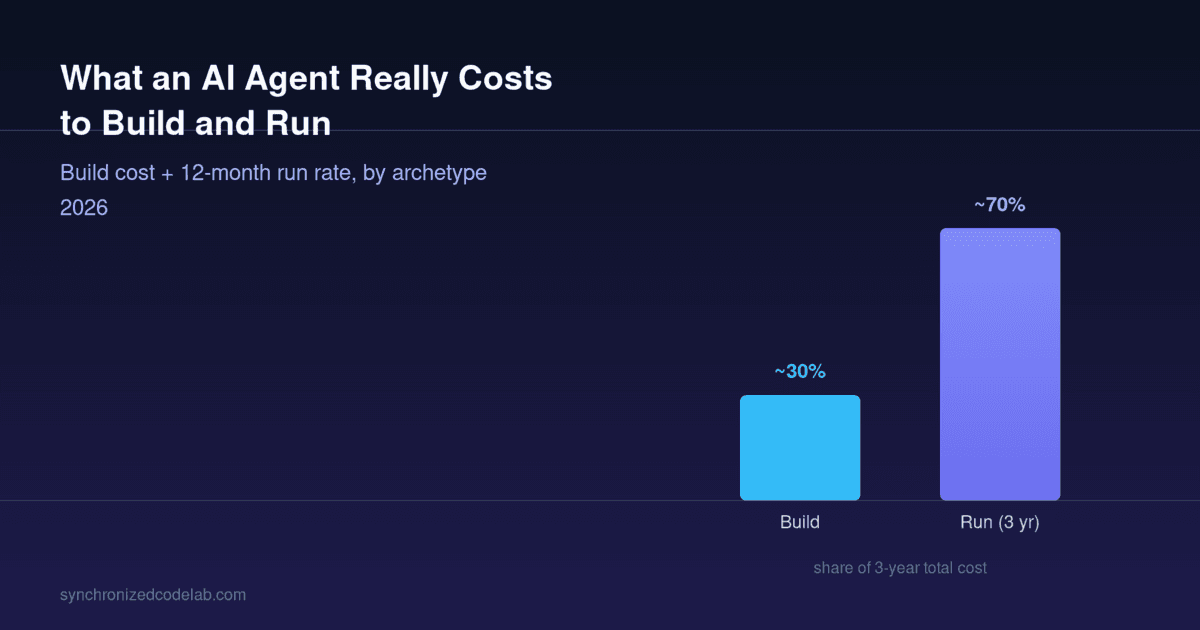
A production AI agent costs $25k-$750k to build - but that is only a quarter to a third of three-year cost. Four archetypes priced twice, build plus 12-month run rate, with every SKU calculation shown.
A production AI agent costs $25k–$750k to build in 2026, but the build is only about a quarter to a third of three-year cost — consumption and maintenance take the rest. A mid-size workflow agent runs $90k–$180k to build and $5.2k–$12.5k per month to operate, putting three-year TCO at roughly $330k–$730k. Inside that monthly run rate, model tokens are typically 70–90% of the bill; the agent platform layer — runtime, gateway, memory — is usually under 3%.
Every figure below derives from published vendor SKUs as of 9 September 2026, with the arithmetic shown. Swap in your own volumes — the shape of the bill does not change.
How much does it cost to build an AI agent in 2026, and what is the 3-year total?
| Tier | Build (one-time) | Year-1 run | 3-year run | 3-year total | Build as % of 3-yr |
|---|---|---|---|---|---|
| Lean — one agent, 1–2 integrations, internal users | $25k–$60k | $18k–$45k | $65k–$164k | $90k–$224k | ~27% |
| Mid-size — multi-step, 3–6 integrations, external users, evals | $90k–$180k | $65k–$150k | $237k–$546k | $327k–$726k | ~26% |
| Enterprise — multi-agent, 10+ integrations, compliance controls | $300k–$750k | $250k–$600k | $910k–$2.18M | $1.21M–$2.93M | ~25% |
3-year run assumes 20% annual consumption growth from adoption (Year 1 × 3.64) and includes maintenance.
Build cost is the wrong anchor because it is the only fixed number in the model. Gartner forecasts that AI inference cost per agentic workflow will rise more than fivefold through 2028, because agentic workloads burn 5–30× more tokens per task than a single chatbot query (Gartner, August 2026).
What does it cost to run an AI agent per month, by archetype?
| Archetype | Build | Monthly run | What dominates |
|---|---|---|---|
| RAG assistant | $30k–$70k | $2.2k–$3.5k | Input tokens + retrieval |
| Workflow agent | $90k–$200k | $5.2k–$9.4k | Calls per task + human review |
| SRE / ops agent | $40k–$120k (integration) | $1.2k–$2.6k | Per-agent floor + telemetry scanned |
| Multi-agent orchestration | $200k–$600k | $8k–$20k | Retries, verification, judge models |
Token math uses Claude Sonnet 4.5 on Bedrock on-demand: $3.00 per million input tokens, $15.00 per million output (Bedrock pricing). Platform math uses AgentCore: Runtime $0.0895/vCPU-hr + $0.00945/GB-hr, Gateway $0.005 per 1,000 invocations, Memory $0.25 per 1,000 events (AgentCore pricing). Google's Agent Platform is comparable (~$0.085/vCPU-hr); Microsoft Foundry charges no agent runtime fee at all.
RAG assistant — $30k–$70k build, ~$2.4k/month
20,000 sessions/month, 3 model calls per session, ~6,000 input and ~800 output tokens per call.
Input    20,000 × 3 × 6,000  = 360M tok × $3/M    = $1,080
Output   20,000 × 3 × 800    =  48M tok × $15/M   =   $720
Runtime  90s sessions, ~50% I/O wait → 250 vCPU-hr =   $22
Memory   2 GB × 90s × 20,000 → 1,000 GB-hr         =   $10
Events   40,000 × $0.25/1,000                      =   $10
Vector store + observability                       =  $550
                                           Total ≈ $2,392
Tokens are 75% of it. The entire AgentCore layer is $42 — under 2%.
Workflow agent — $90k–$200k build, ~$5.2k/month
8,000 task runs/month, 12 model calls per run (context accumulates to ~10,000 input, 600 output per call), 15 tool calls per run.
Input    8,000 × 12 × 10,000 = 960M tok × $3/M   = $2,880
Output   8,000 × 12 × 600    = 57.6M tok × $15/M =   $864
Gateway  120,000 invocations × $0.005/1,000      =  $0.60
Runtime  6-min sessions, 60% I/O wait, 2 vCPU    =    $57
Memory   4 GB × 360s × 8,000 → 3,200 GB-hr       =    $30
Eval / judge tokens (10% prod sampling)          =   $650
Observability + vector store                     =   $700
                                         Total ≈ $5,182
Then add the line most cost models omit: human review. If 8% of runs get flagged and each takes 4 minutes, that is 43 hours/month — about $2,600 at a $60 loaded rate. Budget it, or your $5.2k agent is a $7.8k agent.
SRE / ops agent — $40k–$120k integration, $1.2k–$2.6k/month
You are not building this one; you are integrating and governing it. Azure SRE Agent carries a fixed 4 AAU per agent-hour floor — roughly $292/agent/month at an illustrative $0.10/AAU — before it investigates anything, so three agents cost $876/month idle. Add $150–$600 of token-metered active flow and $200–$1,500 of telemetry scanned: an agent that greps 90 days of logs on every incident bills you for every byte. Full math in our Azure SRE Agent pricing guide; cross-cloud comparison in AWS DevOps Agent vs Azure SRE Agent. Integration spend goes to incident classification, RBAC scoping, and IaC guardrails — not model work.
Multi-agent orchestration — $200k–$600k build, $8k–$20k/month
2,000 complex tasks/month, one orchestrator plus four specialists, ~45 model calls per task at ~12,000 input / 1,200 output.
Input    2,000 × 45 × 12,000 = 1.08B tok × $3/M  = $3,240
Output   2,000 × 45 × 1,200  =  108M tok × $15/M = $1,620
Retry + verification overhead (~30%)             = $1,458
Runtime + memory (AgentCore, 12-min tasks)       =   $132
Trajectory evals (judge models)                  = $1,500
Observability, tracing, MCP servers              = $1,200
                                         Total ≈ $9,150
Retries and verification are the multi-agent tax, and they are not optional — they are what makes the pattern work. Whether that tax is worth paying is covered in when multi-agent systems are worth the cost; the MCP layer is priced in our MCP server cost guide; the orchestration build-vs-buy call sits in OSS vs managed platform pricing. We do not re-litigate those here.
Why do model tokens account for 70–90% of an AI agent's monthly bill?
Because the platform bills on compute-seconds and events, while the model bills on the thing agents generate most of. Here is the workflow agent's bill sorted by share.
| Layer | Monthly | Share |
|---|---|---|
| Model tokens | $3,744 | 72% |
| Eval / judge-model tokens | $650 | 13% |
| Observability + vector store | $700 | 13% |
| Agent runtime (vCPU + GB) | $87 | 1.7% |
| Memory (events + records) | $25 | 0.5% |
| Gateway tool calls | $0.60 | <0.1% |
| Total | $5,207 | 100% |
The entire agent platform layer — runtime, gateway, memory — is $113/month, 2.2% of the bill. That kills the "pick the cheap platform" instinct: moving from AgentCore to Foundry, which charges nothing for agent runtime, saves at most $113/month here. Cutting average input tokens per call by 40% — prompt compression, tighter retrieval filters, cache-friendly prefixes — saves $1,152/month. Ten times the entire platform decision. Gartner's finding that inference will account for 55% of AI-optimised IaaS spending in 2026, overtaking training for the first time, is the same story at industry scale (Gartner, August 2026).
One caveat on the runtime line. AWS states agentic workloads typically spend 30–70% of session time in I/O wait, and AgentCore does not bill CPU during that wait (AgentCore FAQs). Treating vCPU-hours as session wall-clock overstates runtime cost by 1.4–3.3×. Memory is the opposite — it bills peak footprint for the full session including idle.
What actually moves the AI agent budget?
Data prep, routinely underestimated. It regularly equals or exceeds agent engineering effort on the build. BigDATAwire's reporting on Anaconda's State of Data Science survey put data preparation at ~45% of practitioner time (BigDATAwire) — a 2020 figure that pre-dates agentic work, so treat it as directional. Chunking strategy, permission-aware indexing, deduplication, and freshness pipelines separate a demo from a system.
Integrations, priced by write, not read. A read-only pull from a system of record is $4k–$8k. A write — idempotency keys, rollback, audit trail, inspectable failure path — is $15k–$35k. Count your writes before you scope. Regional labour-rate differences are quantified in our India vs USA vs Europe TCO comparison.
Evals, at 15–20% of build. Golden datasets, trajectory scoring, regression gates in CI. Skipping them is the most common reason funded agents die: Gartner expects over 40% of agentic AI projects to be cancelled by end-2027, citing escalating costs, unclear business value, and inadequate risk controls (Gartner, June 2025).
Maintenance at 15–30% of build cost per year. Model deprecations force scheduled re-qualification whether you want it or not. Prompt drift, upstream API changes, corpus rot, and guardrail tuning are continuous, not episodic.
The salary comparison, done honestly. A workflow agent at $7.8k/month all-in is roughly one mid-level US FTE. It is cheaper only if it removes more than that in loaded human time — and MIT Media Lab's Project NANDA found 95% of surveyed GenAI pilots delivered no measurable P&L impact, mostly because the tool never entered the workflow it was bought to change (MIT NANDA, 2025). Scope to a workflow with a countable hour.
What can you realistically build for $25k, $75k, or $200k?
| Budget | What you get | Year-1 run | Read next |
|---|---|---|---|
| $25k–$40k | One RAG assistant, one data source, internal users, propose-only, basic eval set | ~$20k | MCP server cost guide |
| $75k–$120k | Workflow agent, 3–4 integrations with one write path, human-review UI, CI eval gates, observability | ~$65k–$95k | Bedrock token pricing |
| $200k+ | Multi-agent orchestration or a governed ops-agent estate: 8+ integrations, trajectory evals, audit trail, SSO/RBAC, cost controls | ~$180k–$400k | Is multi-agent worth the cost? · OSS vs managed pricing |
FAQ
How much does it cost to build an AI agent in 2026? $25k–$60k for a lean single-purpose agent, $90k–$180k for a mid-size workflow agent, and $300k–$750k for enterprise multi-agent systems with compliance controls. Those are build-only figures. Expect the first twelve months of run cost to add another 70–100% on top.
What does it cost to run a production AI agent per month? $2.2k–$3.5k for a RAG assistant at 20,000 sessions/month, $5.2k–$9.4k for a workflow agent at 8,000 runs/month, and $8k–$20k for multi-agent orchestration at 2,000 complex tasks. Model tokens are 70–90% of each of those figures.
Is an AI agent cheaper than hiring someone? Only if you can count the hours it removes. A workflow agent at ~$7.8k/month all-in is roughly one mid-level US FTE. The comparison works for high-volume, well-bounded tasks with a measurable per-task human time cost — not for "helps everyone be more productive."
How much does AI agent hosting cost on AWS, Azure, or Google Cloud? Less than most teams expect. For a workflow agent at 8,000 runs/month, AgentCore Runtime plus Gateway plus Memory lands near $113/month, Google's Agent Platform is within a few percent, and Microsoft Foundry charges nothing for the agent runtime. Hosting is not where your agent budget goes.
What is the biggest hidden cost in an AI agent project? Two: data preparation on the build side, and human review on the run side. Neither appears on a vendor pricing page, and together they routinely add 40–60% to a naive estimate.
How do I build an AI agent cost calculator for my own workload? Model four inputs — tasks per month, model calls per task, average input tokens per call, average output tokens per call — and multiply by your provider's per-million rates. Add platform SKUs (small), eval tokens at ~15% of production tokens, and human review at flag rate × review minutes × loaded rate.
We build and run these systems. If you have a workload in mind and want the numbers above turned into a defensible model for your volumes — archetype fit, integration count, and a Year-1 run rate you can take into a budget meeting — talk to Synchronized Codelab. We would rather tell you an agent is the wrong shape for your problem before you spend the $90k than after.